Most people sitting poolside in Guanacaste have no idea that one of Central America’s most historically loaded, visually spectacular, and genuinely surprising countries is two hours away by car.
I’ve been leading cross-border tours between Costa Rica and Nicaragua for over a decade, and I still get a kick out of watching people’s faces change the moment we clear the Peñas Blancas border and roll into Rivas. That shift — from manicured resort life to something rawer, louder, and more alive — is exactly why these trips exist.
The Nicaragua activities one day route I’m about to walk you through covers eight stops across roughly 200 kilometers of Nicaraguan road. We move north from the border toward Granada, then swing back south through the Masaya corridor before returning. Every stop is placed where it is for a reason. The sequence is the product. And if you want to know more about how it all fits together as a structured itinerary, check out our private Nicaragua day trip from Guanacaste.
Here’s what a day in Nicaragua actually looks like when you do it right.
You’ve been awake since before 5 AM. The border crossing is behind you, and if you want that part mapped out cleanly, here’s how to cross the Costa Rica–Nicaragua border smoothly on a day trip. And Rivas, “La Ciudad de los Mangos,” greets you with mango trees lining the streets, the clatter of pedal tricycles on flat colonial grid roads, and the smell of something cooking over wood fire.
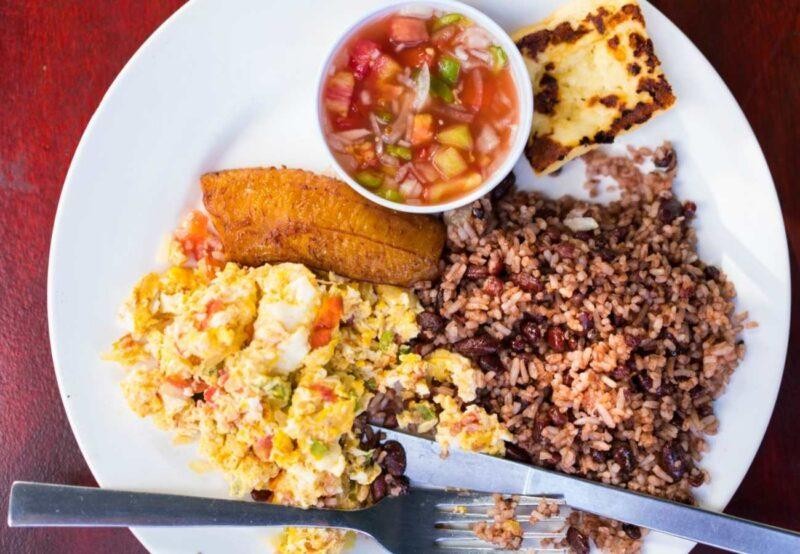
We sit down to gallo pinto — and here’s your first Nicaragua lesson. Costa Rica makes theirs with black beans. Nicaraguans use small red beans, sautéed with rice, onion, garlic, and bell pepper, served alongside fried eggs, cuajada (fresh white cheese), hand-patted corn tortillas, fried ripe plantain, and a pour of crema over everything. It is not subtle. It is exactly what you need after a 4:30 AM departure.
This city has been feeding travelers longer than anyone remembers. The pre-Columbian Nicarao people established a chiefdom here called Kakawatan, a Nawat word meaning “land of cacao water.” That detail is going to come back around later in the day in a way I promise you’ll appreciate.
If you want to understand why the things to do nicaragua day trip route starts here and not somewhere else, the answer is simple: Rivas is 35 kilometers from the border, it’s a real Nicaraguan market town (not a tourist facsimile), and without breakfast here you’re arriving in Granada hungry after an hour and a half of driving. It also fits beautifully as the first stop in the best Nicaragua day-trip itineraries from Guanacaste.
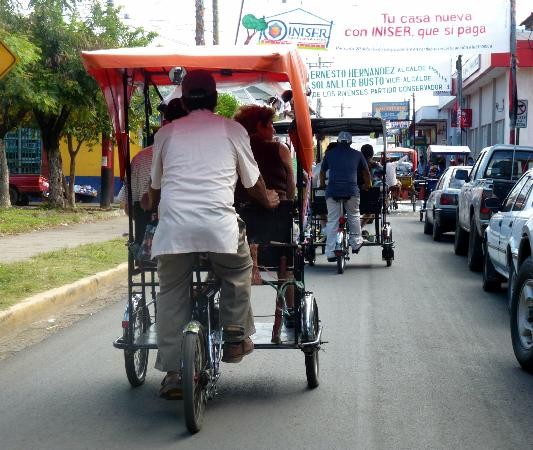
After breakfast, we step outside and board what locals call a **pepano** — a human-powered pedal tricycle with a passenger seat, ridden by a local driver. Not a mototaxi. Not a tuk-tuk. A person pedaling you through the city. The name comes from a Rivas man named Pepano who used to sell frozen treats from his triciclo business. Approximately 2,000 of them operate here, since Rivas has no internal bus system.
The 20-minute circuit takes us past Parque Central, the San Pedro Cathedral with its purple façade (painted using a traditional mixture that, I’m told, includes fertilized eggs), and the Museo de Antropología e Historia, housed in the 18th-century Hacienda Santa Ursula. That building is the actual site where William Walker’s filibusters were defeated.
If you’re arriving from Costa Rica, here is something your school history teacher should have mentioned: April 11, Costa Rica’s national holiday, is directly tied to a battle fought right here in Rivas. On that date in 1856, a young Costa Rican soldier named Juan Santamaría volunteered to set fire to a key filibuster position and was mortally wounded doing it. Costa Rica’s international airport near San José carries his name. The city you’re rolling through on a pedal tricycle is where that happened.
If that April 11 reference is new to you, Costa Rica’s Ministry of Culture has a solid Battle of Rivas and Juan Santamaría explainer that fills in the historical backstory.
Remember Kakawatan, “land of cacao water”? This is where that thread leads.
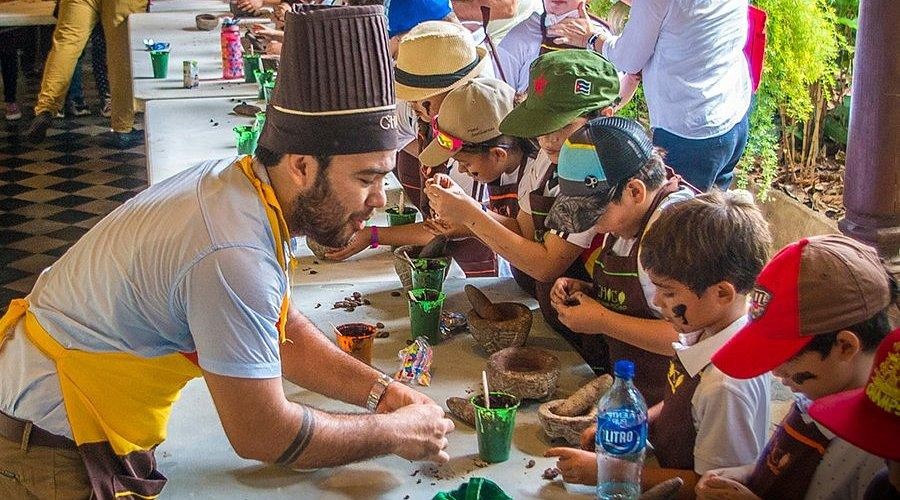
In a colonial courtyard on Calle La Libertad in Granada, the Bate Bate Chocolate workshop pulls you into the full arc of cacao culture in Central America. We put on bright orange aprons, roast raw cacao beans on a stove (they pop like popcorn), shell them into nibs, and grind them by hand in a stone mortar. Then comes the chant.
“Un, dos, tres, cho! Un, dos, tres, co! Un, dos, tres, la! Un, dos, tres, te! Bate, bate, chocolate!” The tempo speeds up. The room speeds up with it. “Bate” is the imperative form of batir — to beat, to stir — and the whole thing comes from a traditional children’s counting rhyme chanted while frothing hot chocolate with a molinillo. It is participatory and genuinely fun, which is not something I can say about every stop on this route.
Tastings come in Maya-style, Aztec-style, and European-style, served in jícaras (dried gourd bowls). You can also choose your own cacao percentage and pour your own chocolate bar into a mold.
Nicaragua is the largest cacao producer in Central America, with roughly 80% of its output classified as “fine flavor” by the International Cocoa Organization. That number should get more attention than it does. For a country that most people primarily associate with volcanoes and colonial cities, it’s a meaningful detail. Christopher Columbus reportedly first tasted cacao in Nicaragua in 1502 — which brings the Kakawatan origin story full circle, from the Nicarao chiefdom in Rivas all the way to this Granada workshop.
The ICCO fine-and-flavour cocoa exporters reference is the right citation for why Nicaragua’s cacao reputation is not just local pride talking.
Here is where things to do nicaragua day trip conversations always end up. Las Isletas are the emotional centerpiece of the day, and they earn it.
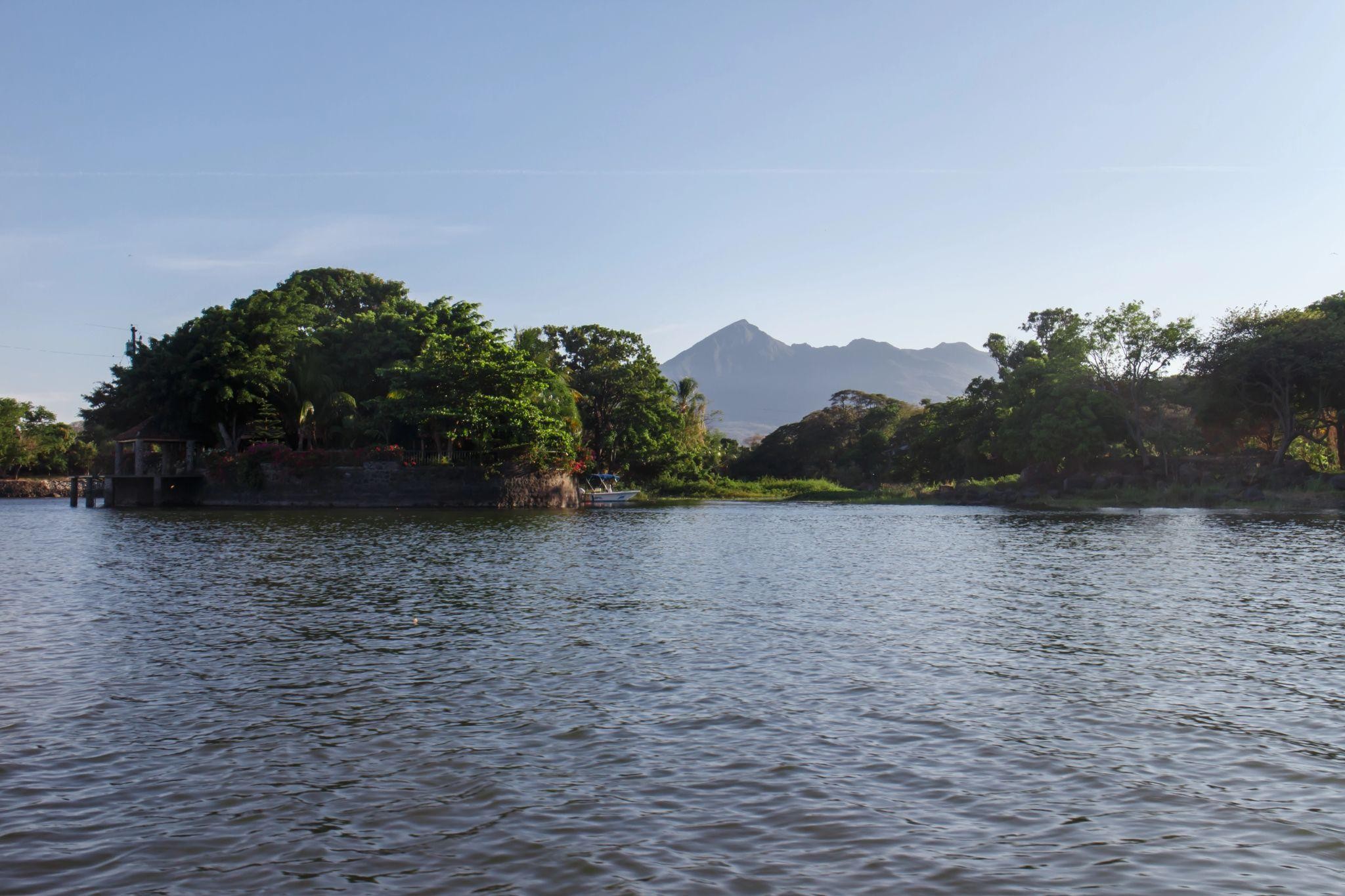
We board a canopy-covered motorized boat at the Puerto Asese dock, about 10 minutes from Granada’s central park, and spend the next 60 minutes winding through narrow channels between hundreds of tiny forested islands. Egrets, cormorants, kingfishers, the Guardabarranco (Nicaragua’s turquoise-browed motmot national bird) on practically every branch. Then Monkey Island, where spider monkeys and white-faced capuchins come to the edge of the foliage and look at you like you’re the tourist attraction, which you are. Volcán Mombacho rising 1,344 meters above the lake the whole time. On clear days, Ometepe’s twin peaks visible across the water.
Here’s the fact you’ll want to share when you get home: the islands were not formed by a volcanic eruption. The northeast flank of Mombacho catastrophically collapsed roughly 20,000 years ago, sending a debris avalanche into Lake Nicaragua that created the entire archipelago. The Smithsonian Institution’s Global Volcanism Program counts approximately 500 small islands. You’ll hear “365, one for each day of the year” from plenty of sources. It’s a good story. It’s also marketing math, not geology.
The Smithsonian Global Volcanism Program documents that Las Isletas were formed by Mombacho’s flank collapse, not by a simple eruption story.
You can read more about whether the boat tour actually fits into a single day’s schedule in Is a Boat Tour of the Islets of Granada Possible in One Day? — the short answer is yes, comfortably.
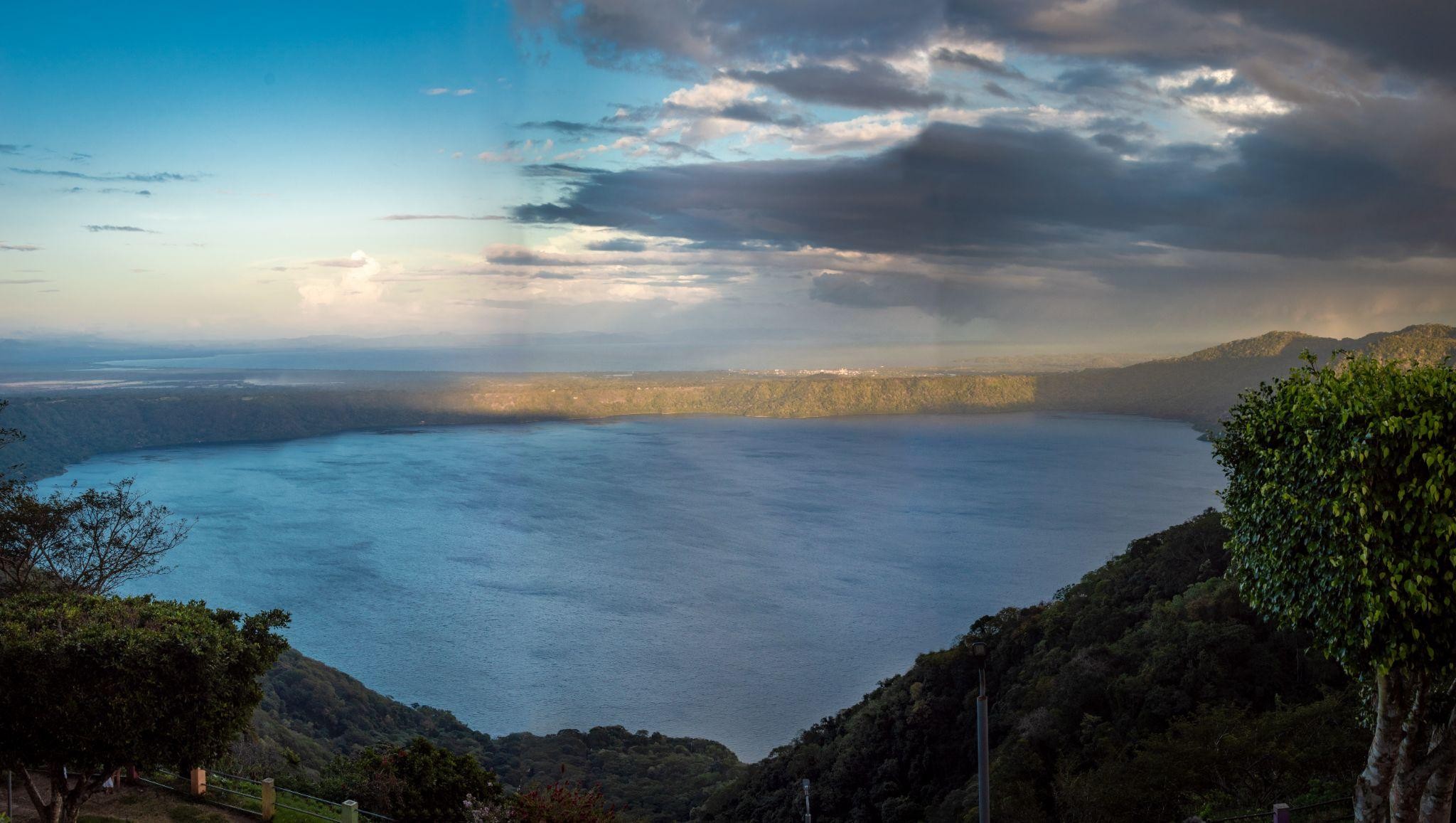
Fifteen minutes south of Masaya, Catarina sits on the rim of the Apoyo Caldera, and stepping out at the mirador delivers the kind of view that makes people stop talking mid-sentence.
Directly below: Laguna de Apoyo, a near-perfect circular crater lake approximately 6.6 kilometers across, 175 meters deep, and a constant 27 to 28°C year-round thanks to underwater volcanic fumaroles. Beyond it: Mombacho. Beyond that: Granada’s rooftops and the expanse of Lake Nicaragua. The lake was declared a nature reserve in 1991, and motorized boats are prohibited. It’s one of the clearest freshwater bodies in Central America.
The viewpoint itself is anything but quiet. Marimba players, street food vendors, hammock sellers, souvenir stalls, the occasional pony. Lonely Planet describes it as arriving “with its own attendant circus,” which is accurate and not necessarily a problem. You’re here for 20 minutes, the photo is immediate, and the energy is part of the experience.
Catarina is one of the Pueblos Blancos (White Villages), a corridor of traditional artisan towns along the Masaya highlands. Neighboring Niquinohomo is Sandino’s birthplace. Diriomo is locally known as “the town of witches.” San Juan de Oriente produces pre-Columbian pottery declared National Cultural Heritage. You’re passing through centuries of layered identity in a 15-minute stop on the crater rim.
One practical note: dry-season visibility here is dramatically different from rainy season. That’s worth knowing before you book. When Is the Best Time of Year for a Nicaragua Day Trip from Guanacaste? gets into the specifics.
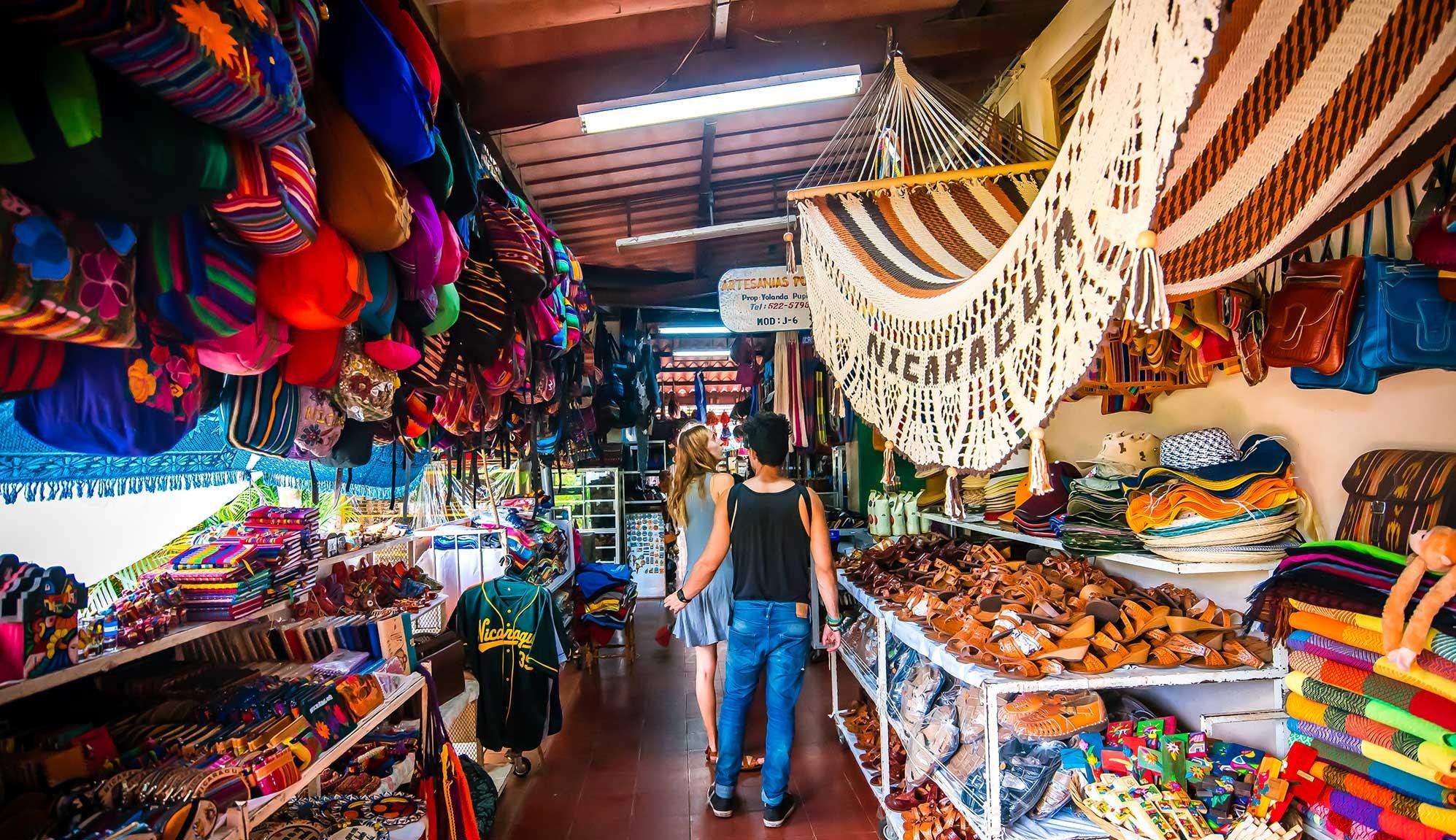
The building looks like a fortress because it essentially is one: stone walls, late-19th-century construction between 1880 and 1891, designed by an English engineer and an Italian engineer for the original Mercado Municipal. Inside, roughly 80 vendor stalls line wide, breezy open-air aisles.
Masaya has been called the hammock capital of Nicaragua, and Frommer’s argues the hammocks here are “arguably the best in the world.” I have no strong objection to that claim. The weaving tradition goes back to the indigenous Chorotega and Nahua peoples, using palm, cotton, and agave fibers. A single hammock takes two to three days to hand-assemble. Prices run $10 to $100 depending on quality, with hammock chairs around $20 to $25.
Beyond hammocks: pottery connected to San Juan de Oriente’s pre-Columbian tradition, primitivist paintings originating from the Solentiname Islands, leather goods, wood carvings (mahogany holds up better in humid climates), guayaberas and embroidered textiles, traditional wooden masks from El Güegüense folklore, pine needle baskets coiled from wrapped pine needles. The market is free to enter, cash-preferred, bargaining expected, and there is a DHL counter inside if you want to ship a hammock home rather than check it.
This is INTUR’s officially designated Mercado Nacional de Artesanías. It is not to be confused with the Mercado Municipal Ernesto Fernández about 700 meters east, which is the working local market and a different experience entirely. Worth knowing before you get out of the vehicle.
INTUR’s Mercado de Artesanías de Masaya listing is the cleanest official confirmation that this is the designated handicrafts market, not the municipal market down the road.
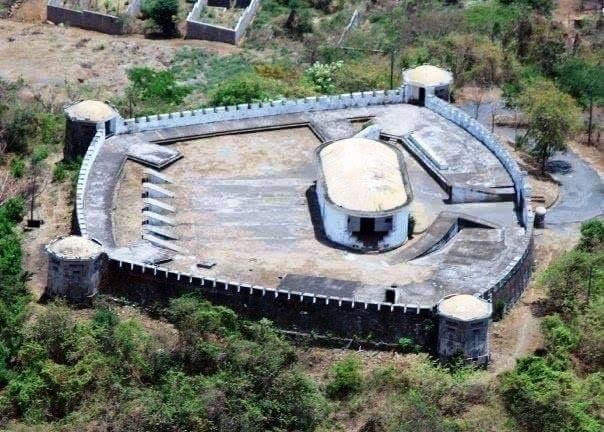
Perched at 360 meters on the northern edge of Masaya, impossible to miss from the highway, El Coyotepe hits you twice. First from above: a sweeping 360-degree panorama covering Volcán Masaya, Laguna de Masaya, the Managua skyline, Mombacho, and Lake Nicaragua. Then from below, once you descend into the underground cells. Bullet holes in the walls. Political graffiti from multiple eras. Forty cells across two levels. Designed for 400 prisoners, reportedly used for over 800 simultaneously.
The Battle of Coyotepe in October 1912 is what made this place. Liberal General Benjamín Zeledón held the hilltop with roughly 350 fighters against approximately 850 US Marines. When the Marines took the hill, Zeledón was captured near Diriomo and his body was paraded through several towns on an oxcart.
A 17-year-old named Augusto César Sandino witnessed that procession. What he saw that day directly sparked his later guerrilla resistance against US occupation, making him Nicaragua’s most revered national hero. One of the officers leading the American assault was Major Smedley Butler, who would later become one of the most decorated Marines in US history and one of America’s most outspoken critics of military imperialism.
The drama in that hill is considerable. The views don’t hurt either.
Let me be straightforward with you, because I think honesty about this particular stop builds more trust than hype does.
The famous Masaya experience you’ve probably seen on Instagram is the night tour, where a glowing lava lake is visible through the crater in the dark. That tour runs 5 to 8 PM. Our itinerary requires clearing the border before it gets too late, so we visit Masaya during the day. You will not see glowing lava. What you will see is everything else, and everything else is substantial.
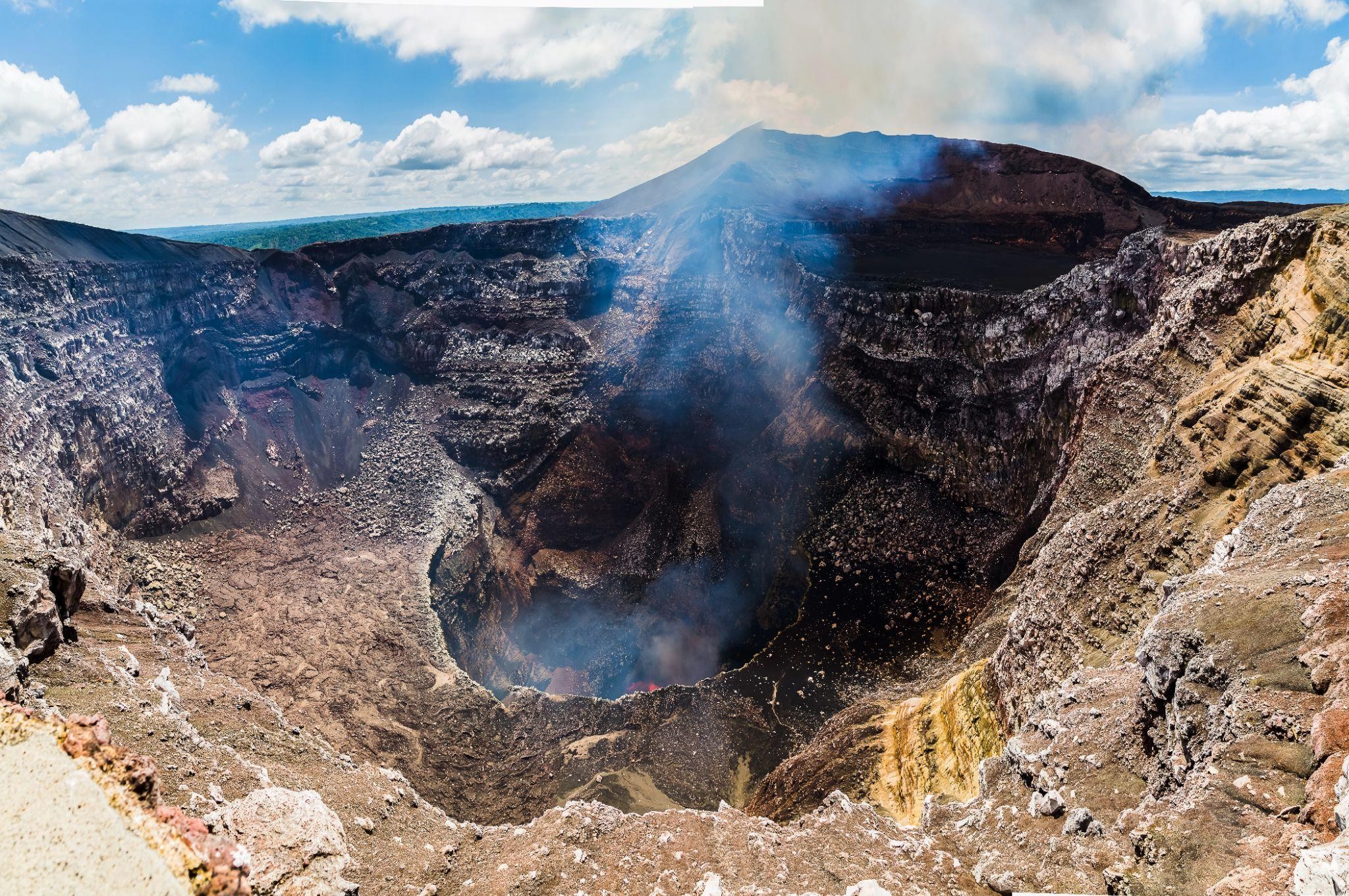
Driving into Parque Nacional Volcán Masaya, Nicaragua’s first national park, you pass through solidified lava fields from eruptions in 1670 and 1772. Frommer’s called it “a surreal mixture of moonscape and shrubbery,” which is close enough to accurate. At the rim of the active Santiago Crater, you park facing downhill, as the signs require, for rapid evacuation if conditions change. You step out into wind and sulfur dioxide and the view of enormous white-gray gas plumes rising continuously from the depths.
INTUR’s Masaya Volcano National Park feature is a useful official reference when you want to support the park’s tourism importance inside the route.
The story of this volcano starts in 1529, when a Spanish Mercedarian friar named Francisco de Bobadilla placed a cross on the crater rim to exorcize the devil from what colonizers called “La Boca del Infierno,” the Mouth of Hell. The indigenous Chorotega had been calling it “Popogatepe” (mountain that burns) and making offerings into the lava for centuries before that. A cross still stands at the same spot, now reached via 280 concrete steps, offering panoramic views across Lago de Masaya, the Managua skyline, and Volcán Momotombo. The daytime visitor center, 2 km from the main entrance, is open only during day hours and covers volcanic geology, eruption prediction, the Ring of Fire, and indigenous mythology.
Then, in the late afternoon, look at the crater. Thousands of Pacific parakeets, chocoyos (Psittacara strenuus), fly in and out of the active crater. They nest in burrows bored into the inner crater walls, roughly three meters deep, inside an environment of continuous sulfurous gases. They are among the few bird populations on earth living inside an active volcanic crater. It is a genuinely strange and wonderful thing to witness.
The night tour gets the Instagram post. The daytime visit gets the geology, the history, and the birds. And unlike the night tour, which regularly involves hour-long queues at the entrance, we walk in and have the place to ourselves.
If you’re wondering how this compares to volcano boarding at Cerro Negro, those are entirely different products on a different itinerary altogether. Can You Volcano-Board at Cerro Negro on a Day Trip from Guanacaste? explains exactly why, and what a León-based adventure day actually involves.
Eight stops. One country. Breakfast in a mango-tree city, a pedal-powered city tour tied to Costa Rican national history, chocolate ground by hand in a colonial courtyard, boat channels between 500 forested islands, a fortress dungeon where Sandino’s story began, a perfect crater lake from a clifftop viewpoint, the best hammocks on the continent, and an active volcano framed by parakeets and colonial mythology.
That is a day in Nicaragua.
If you want the specifics on how we run it, including private vehicle, certified guide, and all border logistics handled for you, start with our private Nicaragua day trip from Guanacaste. Everything you need to decide is there.
Miguel Angel Garcia Lopez is a senior certified national guide with Macuá Tours, based in San Juan del Sur and born in León, Nicaragua. He has been leading cross-border tours between Costa Rica and Nicaragua for over ten years.